


The Gancini Motif: A Hook With a Verifiable Birthday
Most fashion motifs have a fuzzy origin story. Somebody’s grandmother, a saddle fitting, a ship’s rope: the details wander, nobody can pin a year, and the house is usually glad to leave it that way. What makes the Gancini different is that it can be dated. In 1972 Women’s Wear Daily published a photograph of a Ferragamo bag with a hook-shaped metal closure, and that photograph remains the motif’s first documented appearance, verified through the brand’s own foundation. In this industry, a hook that comes with a paper trail is an unusual thing. That is also why the Gancini carries the weight it does across Ferragamo bags today, from an $880 clutch to a python handbag several times that price.
1972, and what makes the date remarkable
The date only lands once you know how young the leather goods were at that point. Salvatore Ferragamo built the house on footwear from 1927; bags only began in 1965, when Fiamma Ferragamo started designing them as accessories to the shoes, and the first press article featuring a Ferragamo bag is dated 1969. That sets the hook in the trade press barely three years after bags became a story worth reporting at all. That timing matters, because it means the motif was not bolted onto an established handbag line in order to give it heritage. It appeared while the category was still being invented inside the house — a working closure on a working bag. A motif that begins as a functioning fastening tends to outlive one that begins as an ornament, and this one has.
Gancio or Gancini? Both belong to the brand
The question of which spelling is right comes up constantly, and the honest answer is that both belong to the brand. Loosely, gancio is the single hook and gancini is the plural, so the motif or the family. In practice the two are used interchangeably by Ferragamo across its own product copy. On the same site and in the same season, current descriptions speak of two golden Gancio buckles on the Hug XS and an iconic Gancini www.feragamoshop.com closure on the Cara. If you are searching a resale platform, try both, since listings inherit whichever word the seller copied off the original tag. Neither word is a slip, and neither denotes a separate product line.
The actual work the hook does on a bag
Three distinct jobs are given to the motif in the collection, and they are worth separating. First comes the clasp: a piece of cast metal that genuinely opens and closes the bag, which is how it appeared in 1972 and how it appears on the Cara today. Second it functions as applied hardware — a plate, buckle or chain link that takes the visual weight without handling the closure, as on the Hug’s wrap straps. Third it functions as pattern — embossed, outlined or woven across leather, canvas and jacquard — so the hook reads as a surface rather than a fitting. Those three registers allow a single motif to run from an entry-level clutch to the top of the range without repeating itself. It also explains how two Gancini bags can look nothing alike yet still come across as the same family.
Where you meet it in the current collection
The most affordable way into the house is the hook, and it is worth putting that plainly. Most first purchases land in the Double Gancini group, which runs from a clutch at $880 through mini shoulder bags at $1,250 to $1,490 and a mini bag at $1,350, up to a top handle XS at $2,500 and crossbodies at $2,400 to $2,900, one of them observed as low as $830. Above that come a Gancini chain mini at $1,850, an outline tote at $1,750 to $1,850, a wallet with chain at $890 and a folded chain clutch at $1,790. The family’s ceiling is a medium Gancini handbag in python with golden hardware, suede lining and a custom key fob at $4,100, listed at 7.2 inches high, 13.3 long and 4.7 wide, with a 21.7-inch strap and an 8.9-inch handle drop. These are all observed 2026 market prices, recorded from the brand’s own United States site on a single day rather than from an official price list. The table traces how the motif takes new forms as the price climbs.
| Item | Form the motif takes | Observed 2026 market price |
|---|---|---|
| Double Gancini clutch | Cast metal clasp | $880 |
| Gancini wallet with chain | Chain-link hardware closure | $890 |
| Double Gancini mini shoulder | Hardware clasp | $1,250 to $1,490 |
| Gancini outline tote | Outlined motif across the body | $1,750 to $1,850 |
| Double Gancini top handle XS | Working structural clasp | $2,500 |
| Gancini handbag, medium, python | Golden hardware, suede lining | $4,100 |
The Vara confusion
One correction needs making here, because it circulates constantly. The Vara is a shoe, not a bag. Created in 1978 by Fiamma Ferragamo, the low-heeled pump with its grosgrain bow has sold more than a million pairs and belongs entirely on the footwear side of the house. It is not a handbag line and never has been, so any reference to a Vara handbag collection is simply wrong. The bow does reach leather goods occasionally as a borrowed detail, most visibly on the Ginny, a Vara-plate bowling bag that turns up in resale rather than in the current line-up. Keeping the two distinct is useful when you shop pre-owned, since a listing that calls the Vara a bag was written by somebody who did not check.
Reading the hardware
Being cast metal, the hook is the part of a Ferragamo bag people examine most closely. Most finishes are gold-tone, a minority silver-tone, and gold-tone plating is precisely that: plated rather than solid, which makes abrasive cleaners a mistake. Beyond that, it is worth being clear about what the brand does and does not publish. No public authentication guide is provided by Ferragamo; its only stated guidance is to buy from its own website or from authorised stores and distributors. What follows is community consensus among pre-owned buyers rather than anything the house has confirmed, and it should be treated as soft signal only. The nearest official equivalent the brand offers to an in-person check is its Repair Services, available for a selection of authentic products at selected boutiques with proof of purchase.
- Crispness, spacing and spelling of the interior leather-tag stamping.
- Casting quality and weight of the Gancini hardware itself.
- The evenness of the stitching along edges, gussets and straps.
- How the leather sits in the hand against known examples.
- The white dust bag and its red drawstring.
The hook second-hand
Gancini pieces behave differently second-hand from the house’s headline silhouette, and the gap is instructive. On a major platform in September 2026, a medium Gancini turnlock flap sat at $1,130 to $1,190, a Gancini Margot hobo $1,020, a medium jacquard Gancini shoulder tote $935 to $1,045 and a small Gancini crossbody $690. A vintage Gancini flap shoulder bag in medium was listed at $560, close to the archive floor. The exception was a large Trifolio tote in embossed Gancini at $2,040, the top of the archive band, in a style no longer in the United States line-up. So the hook holds a broad, steady band of roughly $560 to $1,200 rather than a sharp peak. Gancini pieces appear in brand-operated stores inside outlet villages too, but no official online outlet exists at all, which means any site presenting itself as one is not the brand.
Why a documented birthday matters
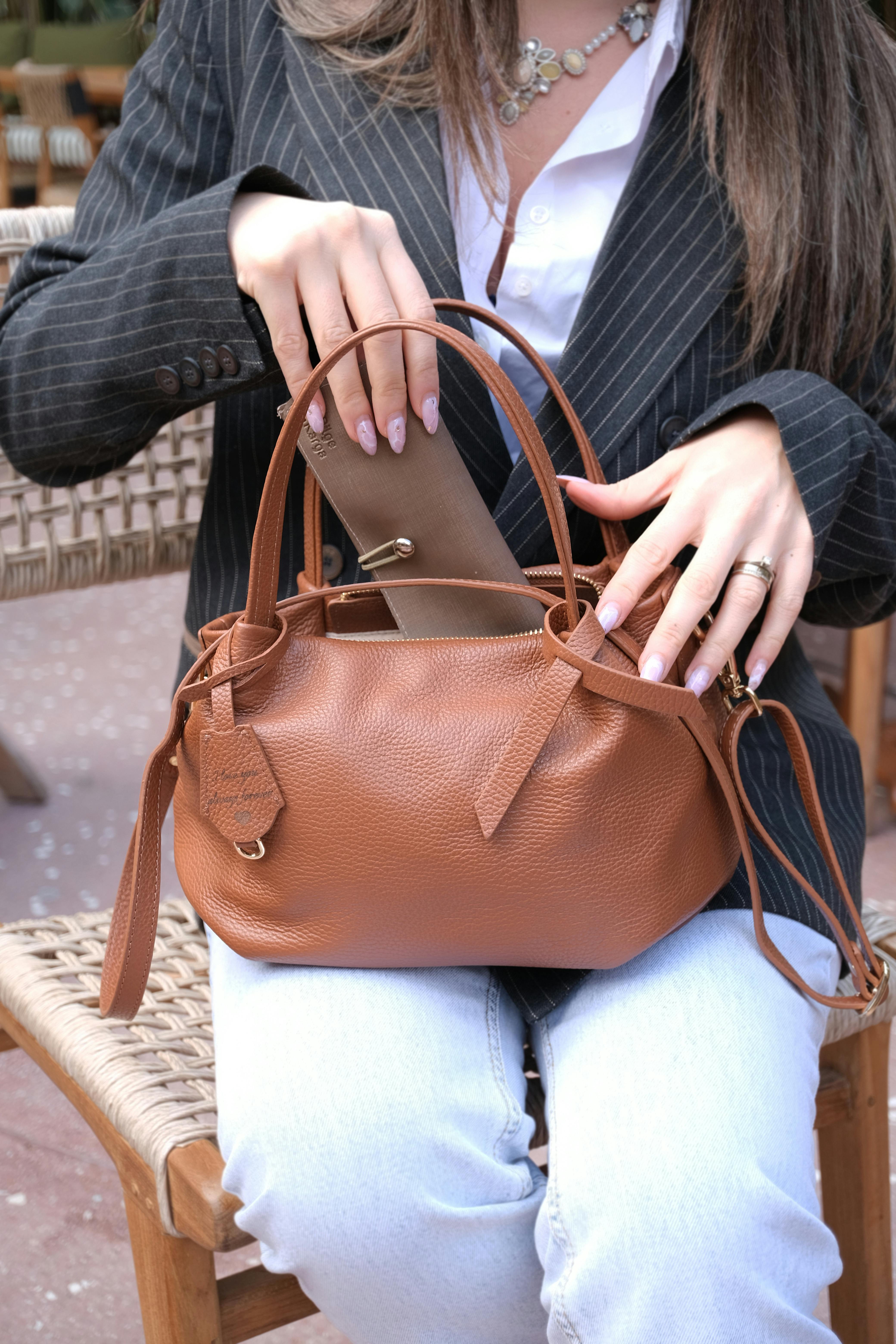
Filing the 1972 photograph as trivia would be tempting, but trivia it is not. A dated first appearance means the motif can be traced rather than merely asserted, which is unusual enough in fashion to count for something. It also means the hook predates almost every current Ferragamo bag, so a Gancini clasp on a 2026 shoulder bag is a real continuation of the archive rather than a revival of it. For a buyer, that continuity is the practical argument: a motif this embedded is unlikely to be quietly dropped, and pieces carrying it stay legible across seasons. Whether you are browsing a Ferragamo shop, holding out for a seasonal Ferragamo sale, or scanning listings that resale platforms still file under Salvatore Ferragamo, the hook is the common thread. It is still doing the same job more than fifty years after a photographer pointed a camera at it.